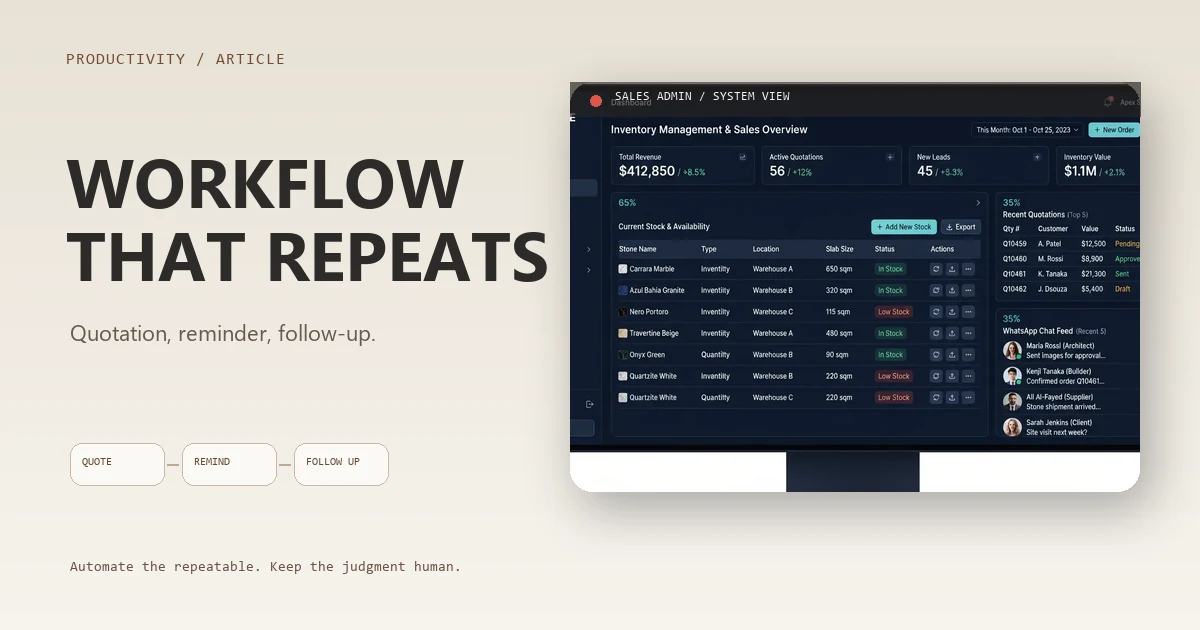
Sales administration contains many repeated steps: preparing quotation drafts, checking invoice reminders, writing campaign messages, and planning follow-up. These tasks are good candidates for workflow support when the rules are clear and the final decision remains visible to the team.
1. Prepare quotation drafts from structured inputs
A workflow can accept approved customer, item, quantity, and pricing inputs, then prepare a document or message draft using the current template. The sales or finance owner should review the output before it is sent, especially when discounts, tax, logistics, or project terms are involved.
2. Surface invoice reminders for review
Instead of relying on memory, the system can identify invoices approaching their due date and prepare the correct reminder. Keep payment status in the authoritative system, prevent duplicate sends, and require an appropriate approval path for sensitive accounts.
3. Use AI for campaign drafts, not campaign truth
Give the model an approved brief, verified product context, target segment, and channel constraints. It can produce several draft directions for the team to review. It should not invent stock, discounts, deadlines, or product performance claims.
4. Design follow-up as a state machine
Follow-up should respond to the lead's stage and behaviour, not only to elapsed time. A reply, handoff, quotation, opt-out, or closed opportunity must stop the current sequence. The sales team should be able to see and override the next action.
A lightweight tool stack
n8n can coordinate the workflow, a CRM or controlled sheet can hold operational state, an approved messaging provider can deliver notifications, and an AI model can classify or draft. Clear data ownership matters more than adding another tool.
The operating rule
Automate work that is repetitive, observable, and reversible. Keep people responsible for negotiation, exceptions, complaints, final commercial decisions, and anything that could create an irreversible customer impact.
The best workflow does not remove the team from the process. It removes avoidable repetition so the team can focus on useful conversations and decisions.