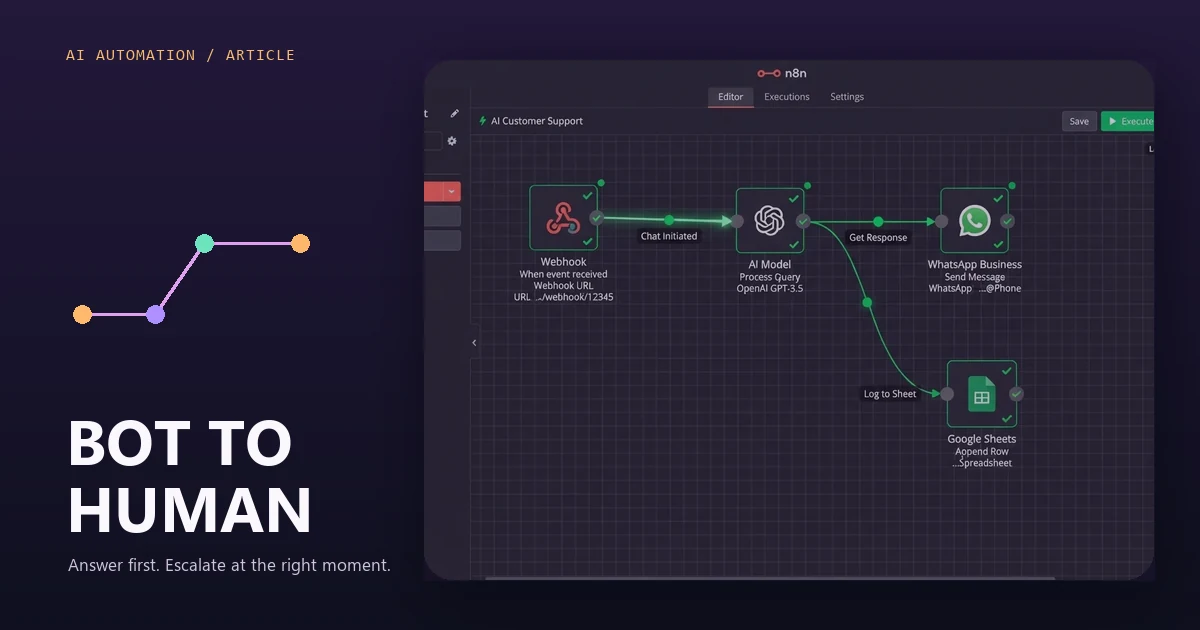
Customer-service agents often fail because the workflow is unclear, not because the model is incapable. A broad prompt such as “be a helpful support agent” gives the system no operational boundaries. A useful agent needs to know what it can answer, when it must stop, and where the conversation goes next.
A practical n8n architecture
A controlled flow can look like this: incoming WhatsApp message → n8n webhook → intent classification → approved knowledge lookup → response draft → human approval or safe automatic reply → CRM log. Purchase intent, quotation requests, complaints, and uncertain answers should move to a person instead of entering an open-ended bot conversation.
1. Limit the agent's authority
Give the agent approved product information, response policies, and clear refusal rules. Do not allow it to promise a price, confirm unverified stock, or create delivery commitments. Retrieval and structured tools should provide the facts; the model should not guess them.
2. Collect useful qualification context
Before the handoff, the agent can ask for material type, estimated area, project location, timeline, and preferred contact method. The purpose is not to interrogate the prospect. It is to give the sales team enough context to continue without repeating the entire conversation.
3. Define explicit escalation conditions
Requests such as “talk to a person,” quotation intent, a complaint, repeated low-confidence answers, or sensitive commercial questions should stop automation immediately. The handoff notification should include the conversation summary and the details already collected.
4. Review logs and improve the workflow
Store the decision path, source information, draft, final response, and handoff outcome where appropriate and privacy-safe. Review failures regularly: which questions lacked source material, which replies required correction, and which conversations escalated too late. Reliability comes from this feedback loop, not from a longer system prompt.
5. Avoid over-automation
In project-based sales, trust and judgment matter. The agent should improve response speed and context collection, while people remain responsible for pricing, negotiation, exceptions, and closing the work.
A good support agent is a controlled part of the operating system, not a replacement for the team.