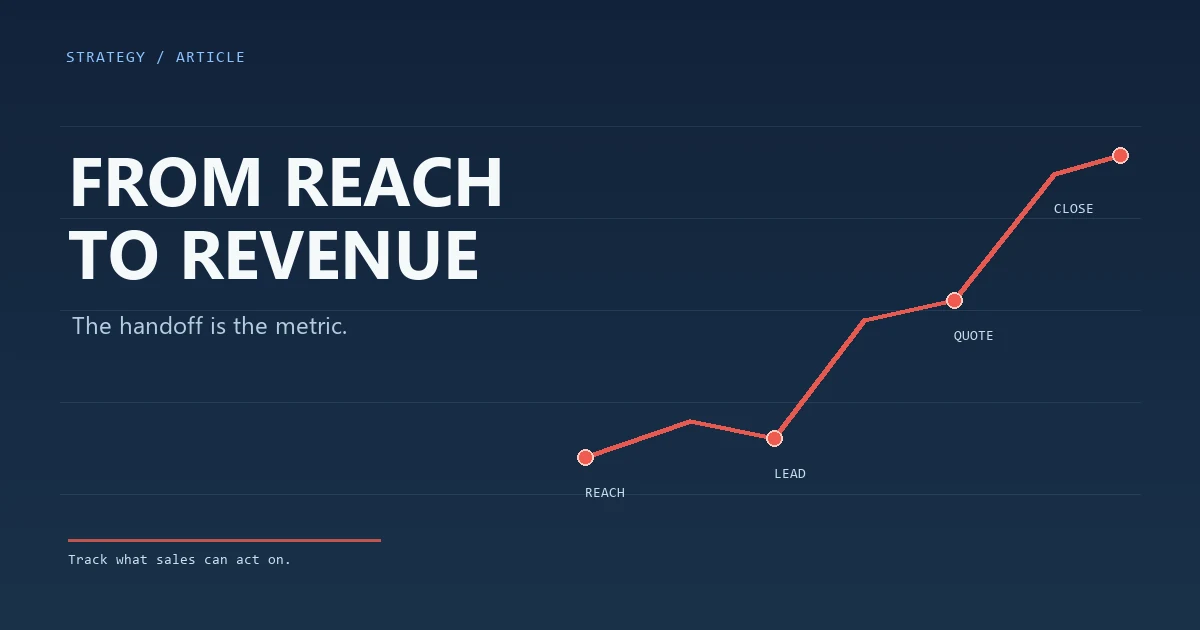
Large reach can be useful, but it does not explain whether marketing is creating valuable conversations. The useful question is not “How big is the number?” It is “What decision can the team make from it?”
Five KPIs worth connecting to the sales process
1. Qualified leads
Track people or organisations with a relevant need, plausible timing, and a path to purchase. Define qualification with the sales team so the metric does not become another marketing-only count.
2. Response time
Measure how long qualified inquiries wait for a useful first response across WhatsApp, email, and direct messages. Fast acknowledgement helps, but the response must also move the conversation forward rather than send a generic greeting.
3. Lead-to-quotation rate
This shows how often a qualified conversation reaches a concrete commercial step. A low rate can point to poor qualification, missing project information, slow handoffs, or a mismatch between campaign promise and actual offer.
4. Quotation-to-decision rate
Track what happens after a quotation is sent. The result is influenced by pricing, product fit, availability, follow-up quality, and procurement timing. It should be read with context, not treated as a score for one team.
5. Cost per qualified lead
Cost per click is useful for media optimisation, but cost per qualified lead is closer to the operating result. Connect campaign source to CRM stage so budget decisions use lead quality, not traffic volume alone.
Connect measurement to ownership
Each KPI needs a definition, an owner, a source, and a review cadence. A simple lead log can be enough to start: source, qualification, stage, next action, and outcome. The objective is a shared view of the funnel, not a dashboard with more charts than decisions.
Vanity metrics describe attention. Operational metrics help the team decide what to improve next.