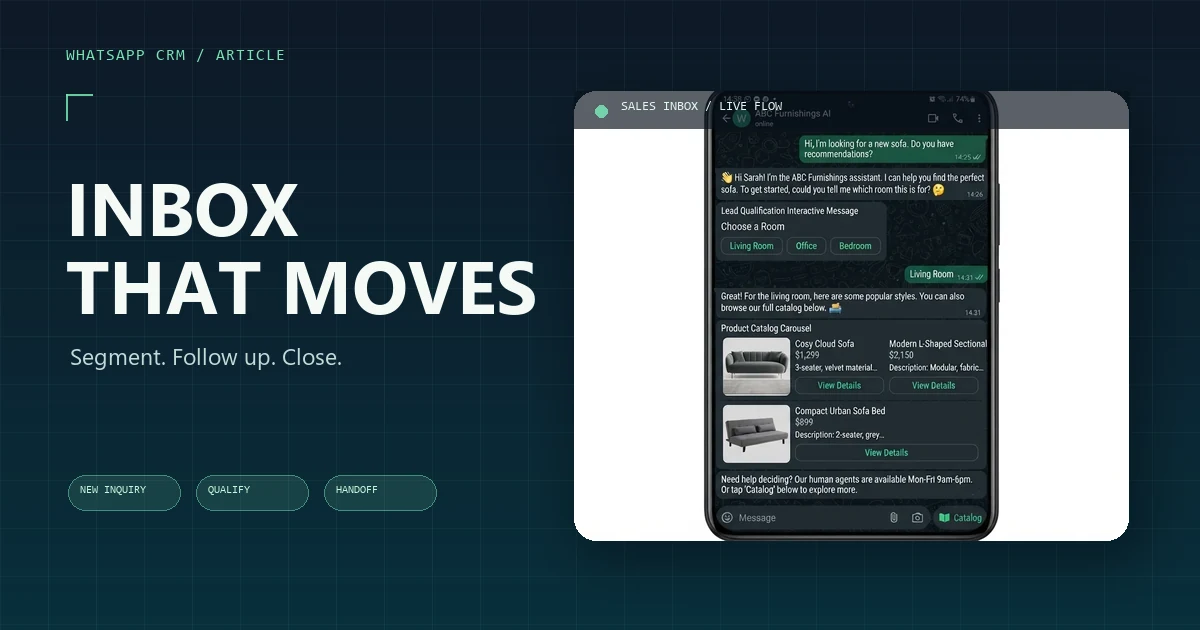
Many marble and granite suppliers have a large WhatsApp contact list but no operating system around it. Product inquiries, old customers, internal groups, and promotional broadcasts all share the same inbox. A serious request can disappear under routine chat, and a missed follow-up can cost the sales team a real opportunity.
The solution does not need to begin with an expensive CRM. A useful first version can combine WhatsApp, a lightweight spreadsheet or CRM, clear ownership, and a small amount of automation.
1. Segment contacts before sending a broadcast
Do not send every promotion to every contact. Start with practical groups such as new leads, warm prospects, existing customers, and inactive contacts. Relevance matters more than broadcast volume. A stock update for a warm architect lead should not use the same message as a general reactivation campaign.
2. Build follow-up templates around real stages
Create a small set of approved templates for the first response, catalogue delivery, stock follow-up, quotation follow-up, and reactivation. Templates reduce repeated writing and keep the tone consistent, but the sales team should still adjust the details to the conversation.
3. Use a simple pipeline
A practical starting pipeline is New → Qualified → Quoted → Follow-up → Won or Inactive. Every contact needs one current stage and one owner. When a quoted lead has no next action, the system should surface it for review rather than silently sending an aggressive sequence.
4. Log the context in a CRM or shared sheet
Capture the source, requested material, project location, estimated timing, current stage, and next action. This creates a basic operating view: where leads come from, where conversations stall, and which handoffs need attention. Without that context, marketing and sales decisions rely too heavily on memory.
5. Keep people in control at the right moment
Automation can classify a message, prepare a draft, or remind the team about an overdue action. It should not invent stock availability, promise a price, or negotiate a project. Once a conversation reaches qualification or quotation, a person should own the decision and the relationship.
The goal is not to automate every message. It is to make sure useful context survives the conversation and the right person knows what to do next.